
Sunshine, stone cottages & the Jurassic Coast.
Dorset is one of the sunnier counties in England, and its older housing stock has its own character worth understanding before you fit solar.
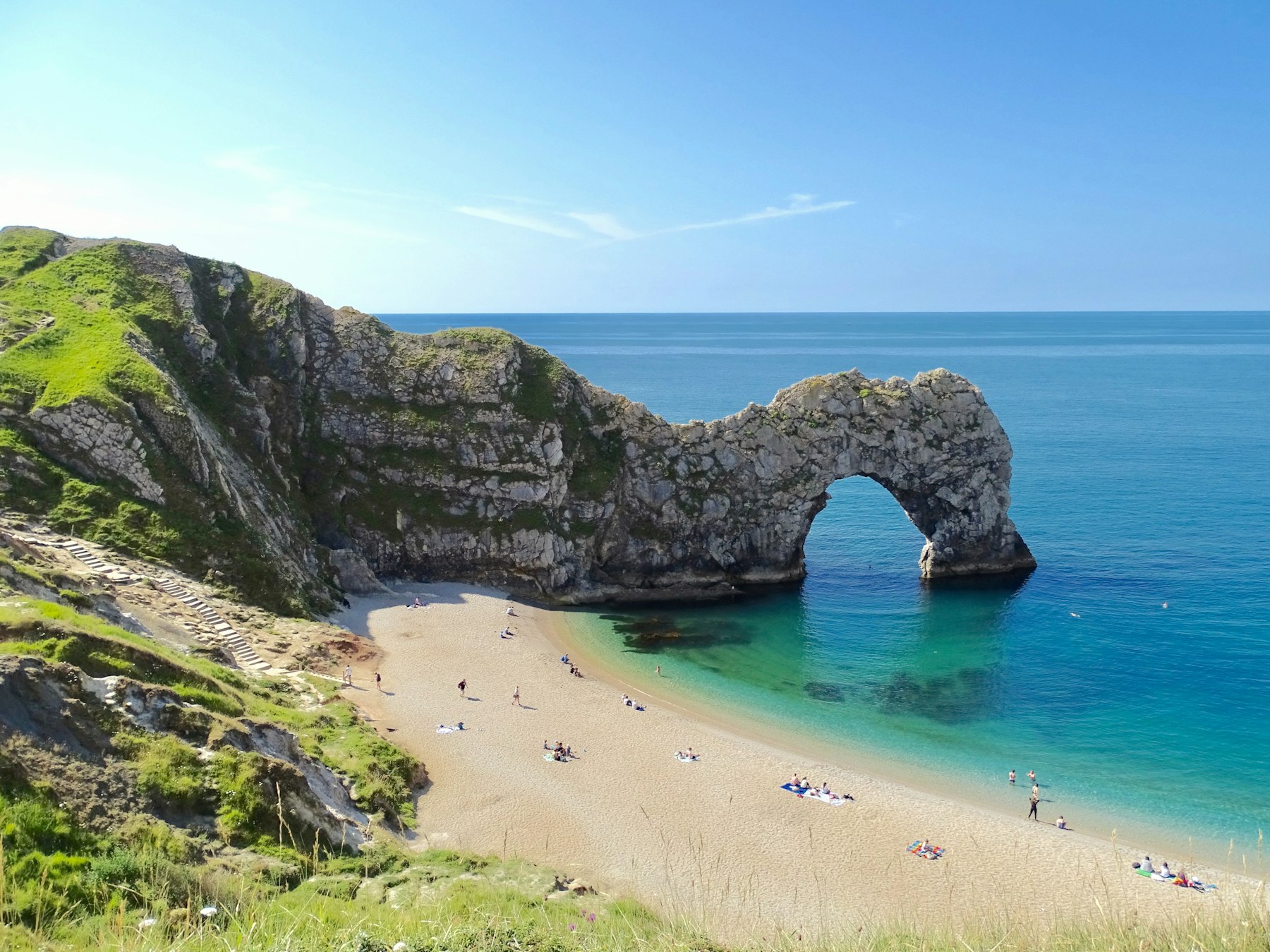 Durdle Door, Jurassic Coast
One of the sunnier counties in England.
How much a solar system generates depends heavily on how much sunshine a location actually gets. Bournemouth sees around 1,780 hours of average annual sunshine (1991–2020), well above the UK-wide average of roughly 1,403 hours, and among the highest figures anywhere in the country.
In practice, that means a solar system in Dorset will generally produce more electricity, and pay itself back faster, than the same system installed in a less sunny part of the country. Your exact figures depend on roof orientation, pitch and shading, which is why every quote starts with a proper site survey.
Stone cottages and thatch.
Dorset has a higher share of older, traditionally built housing than many English counties. Villages across Purbeck and inland Dorset are often built from local Purbeck or Portland stone, and thatched roofs are still common on period cottages, particularly around the Blackmore Vale and the county’s smaller market towns.
None of this rules solar out. It just means the survey has to actually look at what’s on your roof rather than assume a generic tile profile. Thatch can’t take panels directly, in which case a ground-mounted array or an outbuilding roof is usually the better option, and listed buildings need listed building consent for any alteration, solar included.
Stone roofs
Need mounting fixings matched to the material, checked at survey.
Thatched roofs
Can’t take panels directly; a ground-mounted array is usually the answer.
Listed buildings
Always need listed building consent for any alteration, solar included.
The Dorset National Landscape and your roof.
Most homes in Dorset fall under permitted development for solar panels, meaning no planning application is needed, provided panels don’t protrude more than 200mm from the roof plane or sit above the ridge. Part of the county, including much of the Jurassic Coast and the Isle of Purbeck, sits within the Dorset National Landscape (renamed from Area of Outstanding Natural Beauty in November 2023), where visual impact from new development is considered more carefully, and permission can be needed even for installations that would normally be permitted development elsewhere.
Whether your property falls inside the designated area, and whether that changes what you need, depends on the exact location and the specifics of your roof. We check this for every Dorset property as part of your survey.
What this means in practice
For most homes, even those inside the Dorset National Landscape, a straightforward roof-mounted system on an ordinary house is still permitted development. It’s ground-mounted systems, larger or more visible installations, and listed buildings that are more likely to need permission. We’ll tell you which category your property falls into as part of your free survey.
Find out what your roof could generate
Free, no-obligation quote, including a planning check for your property.