
Hold onto the power your panels already made.
A battery banks the electricity your solar array generates in the day so it’s there for the evening, instead of getting exported to the grid at a lower rate. Solar and battery installations are also currently zero-rated for VAT, a relief that runs until 31 March 2027.
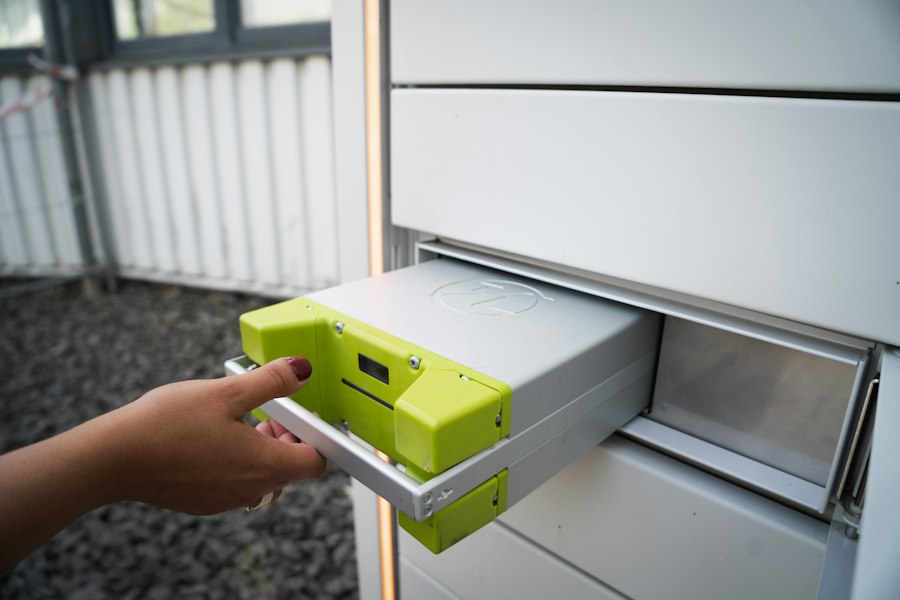 A home battery storage unit
Does it actually pay off for you?
That depends on when your household actually uses electricity. If most of it’s used after your panels stop generating, in the evening, a battery means that daytime generation doesn’t just get exported for a fraction of what it costs to buy back later. We’ll go through your pattern as part of the quote rather than assume a battery suits every home.
Adding one to an existing array is usually straightforward. We check your current inverter and setup first, but most solar systems don’t need replacing or reconfiguring to add storage.
How big a battery do you actually need?
Domestic batteries on the UK market span roughly 5 kWh to 50 kWh-plus, but that top end is built for households with unusually heavy usage, not the average home. A typical 3–4 bedroom house gets through somewhere around 3,500–5,000 kWh a year, and once solar generation has tailed off for the day, evening and overnight usage is usually in the 3–7 kWh range. That puts most Dorset households we quote in the 8–16 kWh usable-capacity bracket.
Averages only get you so far, though. A household cooking, running appliances and charging devices all evening needs more capacity than one that’s out three nights a week. We size every system against what your specific household uses.
There’s more to a battery than storing solar.
Storing your own daytime generation is the main job, but it’s not the only one. Most modern batteries will also top up from the grid overnight on a cheap tariff and discharge through the expensive peak hours, or push stored charge back to the grid under the Smart Export Guarantee when the export rate makes that worthwhile. Whether either is worth setting up depends entirely on your tariff, which we’ll look at as part of your quote.
Can I get a battery without solar panels?
Yes, a battery can run entirely on cheap overnight grid electricity and discharge through peak hours on its own. It pays back faster paired with solar, but it doesn’t require it.
What’s the realistic lifespan of a home battery?
Most lithium batteries fitted in UK homes carry a 10-year warranty, or a set number of charge cycles, whichever comes first, and in practice tend to keep working well past that. Exact terms vary by product and are confirmed in your quote.
Where does it actually go in the house?
Most commonly a garage, utility room or an external wall close to the existing consumer unit and inverter. On older stone-built Dorset properties with solid walls or a smaller footprint, we confirm the best spot on site rather than assuming a standard layout.
Pairs well with.
Solar Panels
Generate the electricity that fills the battery in the first place. Learn more →
EV Charging
Send stored daytime generation into the car instead of the grid. Learn more →
Get a free quote for battery storage
No-obligation quote, tailored to how your household actually runs.